Training to Lead with Wayne South

Training to Lead with Wayne South

ONE HOUR RECORDED WEBINAR FEATURING WAYNE SOUTH AND MIKE SCHENTRUP

VIDEO LINK

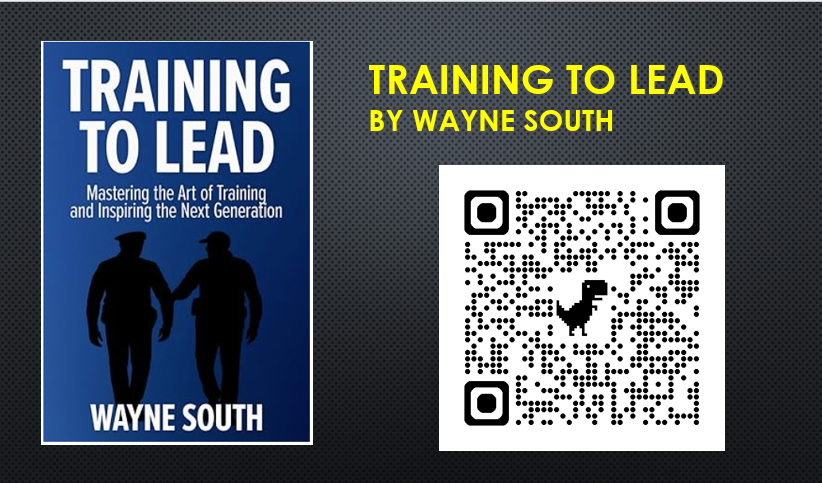
“Training to Lead” is a practical, experience-driven guide for public safety professionals who train, mentor, and shape the next generation. Drawing on three decades in law enforcement and corrections, Wayne South breaks down what it truly takes to be an effective Field Training Officer and frontline leader. This book delivers clear, actionable strategies on adult learning, communication, stress management, feedback, and navigating daily challenges in high-stakes environments. Whether you are beginning your training journey or refining your skills, Training to Lead equips you to inspire professionalism, build confidence, and elevate performance across your agency.

Become a Master FTO – see what it takes to get this sought-after certification. Check out the program here.

Training to Lead on Amazon.

Were You Prepared? A Leadership Article for Training Officers

Written by Wayne South (BIO)

I remember the moment vividly, even though it was twenty-nine years ago. I was a patrol officer at a small agency. It was Thursday morning, and I was patrolling my assigned area.  The radio crackled, and the dispatcher said to return to the station and report to the Chief’s office. Naturally, I did what we all do. I replayed every encounter with a citizen, every traffic stop, and every call I had responded to over the last few days to figure out where a complaint came from.  I walked in, and the Chief didn’t even look up from his desk and said, “Sit.”  The chief was a retired Army Colonel, I thought, “colonels don’t tell people to have a seat, this is bad, I’m getting fired.” The Chief looked up and held out a pair of sergeant’s chevrons. He proceeded to tell me, “You have been doing a good job, and I am promoting you to sergeant, report to the midnight shift on Saturday.”

Was I prepared? Mentally, no. Preparedness is not a simple matter of memorized procedures, equipment checks, or years of experience. It is a leadership discipline, and nowhere is this more evident than in the leadership influence of our training officers. Training officers must be ready for two things at once: the challenge in front of them and the responsibility beside them. Training officers lead from their influence rather than their formal position. This requires a level of preparation that goes far beyond technical skill. What I didn’t realize then was that this feeling of sudden responsibility is the same moment many field training officers experience the first time they receive a trainee: leadership finds you before you are ready for it.

Preparedness is built long before critical incidents occur. It is a blend of competence, mindset, habits, training, and ethical grounding. You simply cannot fake preparation. When that moment arrives, and you get your first trainee, you realize they are relying on you, your judgment, and your ability to train and lead; your preparation is exposed. Trainers should ask themselves, “Am I prepared to not only perform, but to teach, guide, and influence under pressure?”

I believe there are four dimensions of being prepared. They are technical preparedness, mental and emotional preparedness, situational preparedness, and ethical preparedness.

Technical preparedness is the foundation of any high-risk profession. This consists of policies, procedures, tactics, and the ability to communicate effectively. But for the FTO leader, technical skills alone are not enough. A trainee will watch your every move, absorbing your habits long before they understand your explanations. FTO leaders are sending a message, intentionally or not, about what “right” looks like. Technical preparedness is modeling mastery and humility at the same time: “I know my job, and I am committed to learning more.”

Stress does strange things to people. It narrows vision, accelerates our heartbeat, and often drives impulsive decisions that are not technically sound. FTO leaders must be mentally and emotionally prepared to operate under pressure. The trainer must also be able to teach new officers how to survive in this environment. Mental preparedness could include staying calm when others can’t, knowing what your triggers are, and making decisions rather than reacting. Leadership is emotional work. The way you regulate yourself is often more influential than the words you speak.

Situational preparedness is the ability to read a scene, anticipate what’s next, and make decisions based on what you see. Great training officers excel at this. They run mental rehearsals, mentally preparing for multiple outcomes before they occur. The trainer must reinforce these skills in new officers through after-action reviews, situational awareness habits, and asking the “what if” questions. Training is not about producing a perfect response but developing a prepared mind.

Ethical preparedness is where real leadership begins. The public trusts us because they expect us to do the right thing even when nobody is watching or shortcuts are tempting. As a trainer/leader, you should know your “why” and your values. Recognizing when lines start to blur and model integrity daily. This is where trainees begin to learn what kind of professional they will be and where leaders show whether they are truly prepared to lead.

So, I ask you the same question I asked myself twenty-nine years ago, sitting in the Chief’s office, “Am I ready for this?”  In case you are wondering, I reported on the night shift and at our first briefing, I told them the same story. I added the fact that I did not feel prepared, but if we worked as a team, we would be okay. The team accepted my humility and made me a successful sergeant.

So, you may be asking what my first step is in improving my preparedness? Everything discussed in this article, technical competence, mental readiness, situational awareness, ethical decision making, and the ability to lead through influence, is at the heart of what we have built into the Master FTO Program. This program recognizes that FTOs are not just trainers but rather leaders first. They are the first leader a trainee ever follows. Trainers shape culture, teach expectations, and model professionalism in real time, often in moments where preparation makes all the difference.

The Master FTO program is designed to strengthen:

  • Leadership readiness: Helping trainers understand their influence and use it intentionally.
  • Coaching and communication: Building the skills to guide and develop, not simply evaluate.
  • Ethical leadership: Reinforcing the responsibility that comes with shaping the next generation.
  • Preparedness habits: Creating leaders who train for the moment before the moment arrives.

If you are ready to take the next step, check out the Master FTO program at https://waynesouth.com/master-fto  and get started on your journey.

Wayne South is a retired law enforcement lieutenant with 30 years of service and over 25 years of experience as an instructor at both the executive and line levels. He is a nationally recognized leadership and Field Training Officer (FTO) instructor and speaker, serving organizations such as the International Association of Chiefs of Police, Advanced Police Concepts, and the Southwest Virginia Criminal Justice Academy. Wayne provides leadership development, instructor training, and performance coaching that helps officers, supervisors, and executives reach their full potential.

He is the author of multiple publications on modern policing and leadership, including his recently released book Training to Lead, as well as A Lifetime of Service. Wayne holds a Master of Business Administration degree as well as a Master of Arts in Criminal Justice. Wayne serves on the Board of Directors for the Southeastern Field Training Officers Association.

Enhancing Patrol Response to Barricaded Subjects: A three-step strategy

The “3 Cs” can increase the chances of successful decision making and scene management during these complex incidents.

Written By: Lieutenant Charlie Ward (RET)

The topic of a barricaded subject is frequently discussed, but it is usually only addressed in tactical team training or command-level decisions. I’ve noticed that these calls often don’t receive the priority or attention they deserve at the patrol level even though this is typically where such situations arise.

Whether due to a lack of understanding of the situation’s severity, or uncertainty and hesitation about the first steps toward a resolution, patrol officers often proceed as if responding to any other call for service and primarily rely on luck being on their side. This isn’t their fault, as they often lack the necessary knowledge, training and planning on how to initiate the appropriate procedures.

This article is aimed at patrol-level officers, offering a quick, three-step method to employ when responding to a barricaded (or potentially barricaded) subject. These are three simple actions that can help set the event on the right course from the outset.

I’ve labeled them the “3 Cs” of patrol response to a barricaded subject, and they don’t necessarily have to be executed in any specific order. It is just crucial that they are completed and completed quickly. I coined the term the “3 Cs” to help officers remember them under stress. The goal is to execute these three tasks swiftly, allowing you to slow down and process the rest of the situation. While this method isn’t a comprehensive solution for the entire event, it can help guide officers during the initial moments of a patrol response.

Completing these three steps doesn’t guarantee that officers avoid a lethal encounter, the use of force, or any number of unpredictable situations. However, it does increase the chances of effectively managing curveballs and making more successful decisions as the event unfolds. Just like in golf, where a successful drive from the tee box requires properly teeing up the ball, handling a barricaded subject call successfully requires properly setting up your response. Achieve this by accomplishing these three tasks as quickly as possible.

What is a barricaded subject?

For this article, let’s clarify my use of the term “barricaded subject.” I’m referring to situations where a subject, aware or unaware of law enforcement presence, has sequestered themselves within a structure, whether they are alone or not. I approach both scenarios identically, ensuring that if the subject does become truly barricaded, our personnel and teams are already in position and prepared. I’m not referring to a hostage-taker in either case, but rather an individual who is inside a structure with others (such as family, children, friends, etc.). During your planning, it’s crucial to consider what actions should be taken with these individuals.

For the purposes of the initial patrol response, I also do not distinguish between a subject who is armed and one whose armament status is unknown. This approach is based on the preference to have all necessary measures in place should the situation escalate to an armed encounter, rather than being ill-prepared due to uncertainty about the subject’s armament. It’s generally easier to de-escalate and adjust strategies as more information becomes available, rather than having to rapidly escalate under pressure.

The principles I discuss for a barricaded subject can also be applied to scenarios in open-air environments where the subject is confined to a specific area. For instance, I encountered a situation with an armed suicidal subject who had self-inflicted wounds and was isolated in a space akin to a ball field. We managed to contain him to the field, established multiple contact teams with the necessary equipment, and confirmed that he had not committed a crime. However, due to his armed status and mental crisis in the middle of a public facility, we couldn’t depart from the scene.

The Three Cs

These are the 3 Cs for patrol’s initial response to a barricaded subject:

  • Containment
  • Contact team
  • Confirm the crime

Containment

    Containment is a straightforward yet frequently neglected or overlooked strategy when responding to barricaded subjects.

    If a subject’s location is known and they are believed to be inside a structure or a specific open-air area, the initial responding officers must prioritize containment. Often, officers may not have complete information about the situation upon arrival. However, spending valuable time gathering that information without first ensuring containment can risk losing the suspect. They might have been in a specific location, but without containment, they could escape unnoticed.

    Based on the information received from dispatch, if there’s a belief that the incident involves a subject inside a structure or localized area, one of the first priorities in your patrol response should be to contain them within that area.

    Contact Team

    Contact teams are integral to barricaded subject responses. The importance of beginning to establish a contact team as one of your first priorities cannot be emphasized enough. Once it becomes clear that an incident may lead to, or already involves, an individual barricaded in a location, responding officers and supervisors should start coordinating a contact team. This includes deciding who will be on it, what tools they will need and where they need to be positioned.

    This doesn’t require much time. Begin by determining “who” will be on the team and their location. Given the personnel you have available, who are the best “players” to assign to the team? Consider their tactical experience, ability to handle stress, communication skills, and qualifications with certain tools (e.g., shield, ram, LLIM, etc.). If you don’t have someone for every required role, that’s okay. Establish an initial team that can handle the task and adjust as more resources arrive.

    Initial thoughts on location must involve points of cover and concealment. How close can you be while maintaining both? Are there multiple exits, and do you need a team at each? Does the team have security, meaning, can you prevent onlookers and other individuals in the area from approaching or driving up to the team?

    Additionally, don’t fall into the trap of forming a team solely for the purpose of making an arrest, contacting a suspect, or making an entry if exigent circumstances arise. While these are all important tasks that the team may need to complete and should be prepared for, they are not the only tasks.

    The team will also need to manage victims or witnesses that are inside a structure (this is a frequent occurrence so plan for it). Sometimes these individuals exit immediately upon realizing the presence of law enforcement, and the team needs to be ready for that. The team will also be used to provide vital intelligence on the location, surrounding buildings, adjacent areas that may need to be evacuated, etc.

    The contact team plays many roles and will be one of the most valuable components in resolving the situation effectively. Therefore, the sooner a shift can start forming the team, the smoother the decision-making process will be, and the more effective the communication will be as the event progresses.

    Confirm the crime

    Confirming what information you have as soon as possible will help determine priorities and adjust them as new information emerges. We are all aware that the information received during the initial call dispatch is not always accurate or complete. That’s why confirming a crime (gathering pertinent information) and relaying it to the responding personnel is one of my top three priorities.

    Understanding the context within which you are working is crucial. The response and setup for a suicidal individual in a mental crisis will differ from those for a wanted violent felon inside a structure. Both of these scenarios will require different approaches from a response to a suspect who has just committed a non-violent misdemeanor, a hostage-taker, and so on.

    Knowing the elements of a crime and whether they have been met, as well as what the crime is (or isn’t), will help guide the course and the subsequent decisions that need to be made.

    Summary

    Every day, law enforcement officers nationwide respond to calls that involve or could lead to encounters with barricaded or isolated subjects. These incidents require numerous considerations, many of which aren’t time-sensitive and can be addressed as the situation unfolds and as resources or tactical teams arrive. For the initial responding patrol officers and deputies, I’ve found that quickly accomplishing and then communicating the above three tasks − Containment, Contact Teams and Confirmation − often sets them up for success.

    These tasks not only foster an element of confidence within the shift, but they also ensure everyone begins the incident on the same page. Officers know what is needed, what has been accomplished, what gaps might need to be filled, and can then guide the course of the incident. For responding supervisors and command staff, numerous decisions are to be made. Having these three tasks completed and communicated allows them to focus on command-level factors.

    If patrol officers can accomplish these three tasks quickly, they’ll be well-positioned to react and overcome any obstacles that arise during the initial moments of a barricaded subject call.

    Communication is a key element in all these tasks. As officers complete the tasks, they must communicate their progress to everyone else. This prevents duplication of efforts and continues to build confidence among the team and responding supervisors, assuring them that the shift has the incident under control.

    Achieving these 3 C’s − Containment, Contact Teams and Confirmation − is a goal that can help you “control the chaos” in these complex situations.

    About the author


    Lieutenant Charlie Ward (RET) is a 20-year veteran with the Gainesville (Florida) Police Department. He has served on all three of his agency’s tactical units as an operator and as the Team Commander of the Emergency Services Team. In his career he also worked in patrol, undercover narcotics, served as a K9 handler in street crimes and highway interdiction, as a patrol sergeant, and most recently three years as a watch commander. He is currently assigned as an Executive Lieutenant in Operations. He and a fellow Lieutenant helped create and now coordinate the Gainesville Police Department annual Leadership Academy. 
    Ways to Build Trust

    By Mike Schentrup

    Students ask me all the time, how do I build trust with my team. Here are some easy and proven ways to build trust and ultimately, good relationships with your teammates.

    From WatchTower Leadership Solutions.

    • Keep Commitments –  when someone asks you to do something, either one of your team or your boss, follow through. Make sure it doesn’t fall through the cracks.  Keeping you commitments demonstrates the basic level of trust.
    • Deliver Results – or as Jocko Willick says, “PERFORM!”  The is no better way to build trust with your boss and Command than performing well.  Whether as an individual or as the team leader, when a task is assigned, dominate it. And always look for opportunities to help improve your organization.
    • Be present – you can’t be part of team if they never see you. Get out in the field and help. You don’t have to supervise them, just help them.  Let them run the call and just ask what you can do to help.
    • Admit mistakes and apologize – I always say, and I have posted a lot, there is no better way to build trust that to admit when you are wrong.
    • Build relationships – if the cornerstone of leadership is trust, then the BEST way to build trust is through relationships. John Maxwell said, “Nobody cares how much you know until they know how much you care about them.”
    • Extend trust – we must give people our trust before they will trust us.  Trust is a two way street.  We have to extend trust first.
    • Humility – the second cornerstone of leadership.  Humility help you to be open, sometimes even vulnerable, and always approachable.

    Work hard on these things every day and you will build a great team!

    Check out Mike’s leadership course, Leadership for Front Line Supervisors

    Integrity

    By Steve Sweeting (aka Sgt Steve)

    Every Police Officer knows that the #1 rule is “Do not lie”. Our Integrity is the cornerstone of who we are and what we believe in. If you can’t trust a Police Officer, then who can you trust?  Integrity and honesty are so important in our profession,  that lying is usually the one violation capable of having you fired immediately. 

    The whole point of Stoicism is to become a good person, and as a good person, you will be fulfilled and at peace with the world around you. A person who does not have integrity will have A LOT trouble being a good person or being at peace with the world around them. How much stress and anxiety will you have if you are lying and are constantly worried about people learning the truth.? 

    Integrity is more than just not lying. Having integrity means that you are a person who is committed to taking the right action no matter what the circumstance. I like to think of Integrity as being a combination of reliability, good intentions, and honesty. 

    The Stoics didn’t use the word Integrity much. The author Vincent Kennedy said that the Stoics “Saw it (integrity) as part of being human – part of being virtuous.” Kennedy went on to quote Albert Camus the existentialist philosopher who said:

    “Integrity has no need of rules”

    I like this quote, because it speaks to some of the seeming contradictions that Police Officers practicing Stoicism sometimes experience. In order to enforce the law, we are given wide leeway to break many laws. We can speed, run red lights, we can hit people first, we can carry weapons where others aren’t allowed, and we are allowed to lie to suspects and offenders during investigations. If you aren’t constantly focused on being a good person, it may be easy to lose your way with all of this rule and law breaking. On the other hand, if you have integrity, it is fairly easy to understand when and where the rules apply to you and when they don’t. 

    • You can run that redlight to go save someone in an emergency, you shouldn’t run that redlight just because you don’t feel like waiting. 
    • You can lie to that suspect, or tell half-truths in the pursuit of justice, but you can’t lie on your timecard or to your spouse. 
    • You can tackle a suspect who is about to resist, but you can’t hit someone just because they annoy you. 

    Check out more of Steve’s content here.

    While the Stoics didn’t use the word “integrity” much if you explore their works, you can draw some pretty obvious conclusions about what they thought. Marcus Aurelius had a lot to say on the topic, and he was often succinct and to the point: 

    Do not act as if you were going to live ten thousand years. Death hangs over you. While you live, while it is in your power, be good.

    – Marcus Aurelius

    Never esteem anything as of advantage to you that will make you break your word or lose your self-respect.

    -Marcus Aurelius

    A man should be upright, not kept upright.

    -Marcus Aurelius

    If it is not right do not do it; if it is not true do not say it.

    -Marcus Aurelius

    While your reputation is something that is outside of your control in many ways, you can influence others to have a positive perception of you. In Law Enforcement, the number one way to accomplish this is to have a high degree of integrity. If you practice integrity and honesty it will be obvious to all you deal with. 

    “How rotten and fraudulent when people say they intend to ‘give it to you straight.’ What are you up to, dear friend? It shouldn’t need your announcement, but be readily seen, as if written on your forehead, heard in the ring of your voice, a flash in your eyes — just as the beloved sees it all in the lover’s glance. In short, the straightforward and good person should be like a smelly goat — you know when they are in the room with you.”

    —Marcus Aurelius 

    I’ll leave you with one last thought and quote from the great Marcus Aurelius. If you have not been being a person with integrity, if you have piled up the lies and it feels like there is no way out. If you have made a habit out of lying to yourself and others, Stop it, and start behaving better. Start being a person that you respect. If you have to lie cheat or steal to obtain or keep a thing, you probably don’t need it.

    If you are lying to maintain a relationship, consider that the person you are lying to isn’t in a relationship with you, they are actually with the fake version of you that will cease to exist the second that the truth is found out. Whatever situation you are in, if you are looking to live a better more meaningful life, Marcus Aurelius has some good advice. 

    “Waste no more time arguing what a good man should be. Be one.” 

    – Marcus Aurelius

    Behaving with integrity can be a challenge at first, but it is achievable and worth the effort. If you follow the four stoic virtues (Wisdom, Justice, Courage, and Temperance), behaving with integrity should come fairly naturally. 

    Deescalate Yourself First

    By Steve Sweeting (aka Sgt Steve)

    We’ve all encountered that one coworker who storms onto the scene like a hurricane, instantly escalating tensions and disrupting any semblance of calm. More often than not, their agitation started long before they stepped out of their vehicle, and their frenzied, combative demeanor is like throwing gasoline on a smoldering fire. The hard truth is that you cannot be an effective part of the solution if you are, in fact, contributing to the problem, especially when it comes to the critical skill of deescalation. That’s why it’s absolutely essential for Officers to master the art of deescalating themselves first, setting the stage for successful conflict resolution and maintaining the peace.

    In today’s challenging environment, deescalation techniques have become essential tools for LEOs on the job. Drawing from battle-tested Stoic philosophy, which emphasizes rationality, self-control, and emotional mastery, LEOs can develop a unique skill set to successfully deescalate tense situations.

    The Stoic Approach: Master Your Emotions

    As a LEO, you are constantly faced with situations that can provoke strong emotions. This is where the Stoic philosophy can offer valuable guidance. At its core, Stoicism teaches that we cannot control external events, but we can control our reactions to them. By focusing on what is within our control and learning to master our emotions, we can maintain our composure during difficult encounters.

    “Make the best use of what is in your power, and take the rest as it happens.” 

    – Epictetus

    This emotional control is crucial in deescalation. When you’re able to manage your emotions, you’re less likely to respond impulsively or aggressively, giving you the ability to communicate effectively with the individuals you encounter. In turn, this fosters trust and cooperation, making it easier for you to gain compliance and resolve the situation peacefully.

    Check out more of Steve’s content here.

    Deescalate Yourself First: The Stoic Checklist

    1. Recognize your emotions: Take a moment to acknowledge and identify the emotions you’re experiencing. This self-awareness is the first step towards emotional mastery.
    2. Separate yourself from your emotions: Remind yourself that you are not your emotions. They are simply temporary reactions to external events. By detaching yourself from your emotions, you can observe them objectively and prevent them from dictating your actions.
    3. Focus on what is within your control: Instead of fixating on external events, concentrate on what you can control, such as your thoughts, actions, and reactions. This shift in focus empowers you to maintain your composure and make rational decisions.
    4. Practice negative visualization: Visualize the worst-case scenario in your current situation. By doing so, you mentally prepare yourself for potential difficulties and develop resilience in the face of adversity.
    5. Reflect on your role as a LEO: Remember your duty to protect and serve the community. Focus on the long-term consequences of your actions and strive to make decisions that align with your professional responsibilities and ethical principles.

    Deescalation Techniques: The Stoic Approach

    With a calm and rational mindset established, you can apply the following Stoic-inspired deescalation techniques:

    1. Active listening: Give your full attention to the individual you’re speaking with. This demonstrates respect and understanding, which can help to establish trust and defuse tension. Stoic mindfulness can help with this.
    2. Empathetic communication: Acknowledge the individual’s emotions and perspective, even if you don’t agree with them. This validation can help to ease tensions and open the door to cooperation. The stoic virtue of justice can help with this. 
    3. Seek common ground: Identify shared goals or values and use them as a basis for collaboration. This can foster a sense of unity and facilitate peaceful resolutions. The Stoic virtue of wisdom is relevant to this skill. 
    4. Maintain a confident and non-threatening posture: Your body language can significantly impact the outcome of an interaction. By projecting confidence and non-aggression, you can encourage cooperation and minimize the risk of violence. Utilize your discipline to keep control of your body and how you are outwardly presenting yourself.

    By employing the Stoic principles of emotional control and rationality, LEOs can effectively deescalate tense situations and ensure the safety of all parties involved. By first deescalating yourself, you create the foundation for successful and peaceful resolution of conflicts. It’s important to remain open to new approaches that can enhance our abilities to serve and protect our communities. Embracing Stoic philosophy and incorporating its teachings into our deescalation techniques can provide valuable tools for navigating the complex and challenging situations we face daily.

    Remember, it all starts with you. Deescalate yourself first. 

    Hope and Stoicism – they are the same

    Written by: Sergeant Steve Sweeting

    In my travels and experiences teaching Stoicism to LEOs, I have all kinds of conversations with many different people. I engage with everyone and try to listen to all points of view. I often value the critics because they challenge me and my ideas. They help me refine my thinking and sharpen it to a fine point. That’s where today’s newsletter starts: a conversation with a critic.

    I was speaking with a Ph.D. (psychologist and researcher) who works with LEOs. She had no idea who I was, so during our conversation I mentioned that I write and teach about Stoic philosophy, mainly sharing it with my community of LEOs. She quickly announced she’d “looked into Stoicism” and found a “fatal flaw” in the philosophy… “GASP!” I took a Stoic mental pause and said, “Tell me more about that.” She had determined that Stoicism was completely devoid of hope, something she said she relies upon daily and something she couldn’t live without. She had obviously made up her mind, but in that objection to Stoic philosophy, she had given me something to think about.

    So, I’ve been thinking about it and coming back to it time and time again until I’ve found some clarity and decided what I want to say about the idea of hope.

    Fast forward to recent events. My beautiful new niece and goddaughter was just born a few days ago. I can already tell that she and I are going to be great friends. Her parents kept the name a secret until after she was born. Her name is Hope.

    Being a proud uncle and a freshly minted godfather, I started thinking: What can I do? What presents can I buy? What can I do to help? What needs can I help meet for the tired parents? One thing I thought would be cool is to go buy some newspapers from the day of her birth. My plan: throw them in my safe for 18 years, then in 2043 on her 18th birthday, we will have a cool present to give her. At that point I’ll probably have to explain what newspapers are.

    Sign up for Steve’s FREE weekly newsletter here.

    So my wife and I made a late night trip to the store and hit the newspaper rack. The irony punched me in the face. Here we are buying presents for 18 years from now, for a precious little baby named Hope, and the newspaper headlines inspire anything but hope. Absolutely horrible news, disaster, outrage, war, death, and so much more. You look at the news in black and white and wonder: what kind of world will this baby grow up in? Will we even last another 18 years?

    Is there any hope for Hope?

    I started reaching for my Stoic mental tool belt in this moment, and the question posed by our Ph.D. friend suddenly went from philosophical abstract to practical reality in my mind. Where in this set of tools and tactics do I find a way to have hope for the future?

    After a quick mental pat down, I started breathing easy. I still felt optimistic about the future, confident that in 18 years I’ll be handing her these newspapers and explaining how they used to print information on slices of dead trees. I have hope, I feel quite a bit of it, but where is it coming from?

    I think the Stoic practice of examining impressions and challenging perceptions is a means for developing hope. Weighing that against my experience, I’ve lived through 9/11, too many hurricanes to count, people have tried to kill me, the worst era in the history of law enforcement, turmoil, upheaval, the birth of the home computer, the birth of the internet, the rise of AI, and so much more. Yet here I am, comfortable and happy, sitting in my bed writing about hope.

    “I judge you unfortunate because you have never lived through misfortune. You have passed through life without an opponent. No one can ever know what you are capable of, not even you.“
    — Seneca


    I think the Dichotomy of Control, developing strength, and building resiliency all come together to create a worldview that is very hopeful. Will there be hard times in the future? Yes, absolutely. Am I prepared for that future? Yes, absolutely. I have confidence that the future will work out and that I’ll handle whatever form that future takes. It feels like hope to me.

    “Never let the future disturb you. You will meet it, if you have to, with the same weapons of reason which today arm you against the present.”
    — Marcus Aurelius


    For my more advanced philosophical readers: if you just google “Stoic quotes about hope,” you will probably get a lot of quotes that sound like Stoicism teaches against having hope. Quotes like this:

    “Hecato says, ‘cease to hope and you will cease to fear.’… The two of them march in unison like a prisoner and the escort he is handcuffed to.”
    — Seneca


    But examine what Seneca is saying and you might just come away with a different understanding. He is saying that hope and fear are linked and connected. For example: When we say that we “hope” that something doesn’t happen, we are expressing a fear of something. Or when we say we “hope” things turn around or get better, we are saying that a bad thing or something fearful has happened and we “hope” that it changes.

    But what if you took fear out of the equation? What if you pulled out the handcuff key and unshackled hope from fear? What if you feared nothing and were confident in your ability to handle all outcomes? What if you had the absolute belief that things would turn out fine? How would we describe a person like that? I think we would say that they are an incredibly hopeful person. How would it feel not to have fear about the future? I think you would find it hard to distinguish that lack of fear from an abundance of hope.

    So where in Stoicism does it say that it is a Virtue to be hopeful? I think just below the surface it is baked in and part of the Stoic DNA. It is right there in the four cardinal Virtues: Courage. The ability to overcome fear. Defeating fear rewards you with a whole lot of hope.

    One last thing: There is a finer point to be made here. I still ride around with a large Velcro patch on my car carrier, and on a solid black background in large bold white letters it says “Hope is not a good plan.” I stand by that. Hope is not a good plan; it is not a valid strategy; it’s not a tactic that serves you. I could easily design more patches that express similar truths.

    • Wishing is not a good plan
    • Happiness is not a good plan
    • Comfort is not a good plan
    • Anger is not a good plan
    • Knowing the right people is not a good plan
    • Optics is not a good plan 

    I am no more “anti-hope” than Seneca was, but I understand the nuance of it. Good leaders inspire hope; they give hope; they do not rely on hope as a strategy. Hope is a good, positive feeling. Hope is a reward for courage, not something that replaces the need for it. 


    Amor Fati
    – Sgt. Steve

    StreetStoic.com

    Category and Location Clustering

    Investigative Interviewing – Category and Location Clustering

    WRITTEN BY:

    Rui Paulo – Liverpool; John Moores University, United Kingdom

    Mark Severino – Los Angeles Police Department (Ret.), United States

    Science-based techniques are key for obtaining detailed and accurate accounts from witnesses and victims. However, some techniques like the change order mnemonic or a witness-compatible questioning can be too complex or challenging to use and sometimes elicit a limited amount of new information. To address this, Paulo et al. (2021) developed two retrieval strategies that could apply to most crimes/events and are easily adapted/used by detectives with various levels of training: Category Clustering Recall (CCR) and Location Clustering Recall (LCR).

    CCR consists of asking eyewitnesses to recall a crime using broad information categories that are present in most crimes to guide and organize their recall (e.g., person-related details, object/ environmental-related details, location-related details, action-related details, and auditory information). This is based on research suggesting that focusing on one specific cluster at a time can trigger relevant associated memories that otherwise might not be recalled.

    LCR consists of asking eyewitnesses to recall a crime using locations to guide and organize their recall. Therefore, witnesses are asked to focus and recall information concerning each separate location of the crime scene, one at a time. This was based on research suggesting that locations can be effective cues for enhancing episodic memory.

    These techniques were initially intended to be used after a free recall to obtain additional detail from witnesses. In the lab, CCR was found to be more effective in eliciting information after a free recall in comparison with the change order mnemonic (Paulo et al., 2016) and witness-compatible questioning (Paulo et al., 2017). However, recent research suggests these techniques might also be more effective (and possibly replace) a free recall (Paulo et al., 2021; Shahvaroughi et al., 2021; Thorley, 2018).

    There are several ways we would use the CCR/LCR concepts.

    After the free recall, I would ask the subject to concentrate on PLATO topics individually. The problem I have with the context reinstatement mnemonic is it is a large request (e.g., concentrate on the people, actions, objects, odors, emotions felt, etc.) Too large of a request for a victim/witness who is having problems concentrating and many times too general.

    CCR on the other hand allows the subject to concentrate on one topic at a time. The other advantage of CCR is I can include as many general topics as needed specific to the investigation/interview. For example, with the context reinstatement mnemonic, I could ask for objects observed and would receive a general description. With CCR, I would ask to concentrate on objects. Description of said objects, color, size, weight, markings, scratches exact locations, etc. The sketch Plan works hand in hand with CCR. The subject could draw the object, articulate the markings, etc. The Sketch Plan facilitates communication during CCR.  

    The same holds for Location Clustering. Locations can be different areas of a room the subject went to, and different rooms the subject was placed in (e.g., a kidnapped subject was moved and tortured in different rooms within a large commercial structure. The subject was tortured in each room by different suspects using different means). Locations can be physical locations the subject visited or was forced to travel to. This works very well with Haneen Deeb’s Mapping research. Location Clustering allows the subject to concentrate on one location at a time. This also works well with the Timeline technique, when the event being investigated is spread out over hours/days.

    I have used the CCR concept when explaining the interview process (pre-free recall) and advising the subject to think about the different CCR categories. I like front-loading the categories before the free recall. After obtaining the free recall, I would select the topics from the free recall that required further follow-up. After exhausting the subject’s memory recall, I would still ask the subject to think about CCR general categories (PLATO) even if they were not mentioned during free recall. It is common for subjects to remember more when concentrating on one category at a time. (e.g., a witness who observed several people sitting in a vehicle only gave a general description during free recall. However, when asked to only concentrate on the individuals we obtained more fine-grain detail on the occupants as well as the subject remembering another person who had walked by the vehicle. Thus, another witness. This is compatible with laboratory research from Paulo et al. (2016) and Paulo et al., (2017) suggesting CCR can be effective in eliciting detailed information after a free recall, particularly person-related details.  

    In a tactical situation when debriefing a witness (e.g., active shooter), the CCR concept is useful when we need specific information promptly. There is no time for CI/free recall, that would come much later. The CCR is a very flexible concept and appears to be easy to understand for the subject and flexible for the interviewer. Anytime a subject can concentrate on a single topic, we always receive more information vs. a request that includes many topics.

    When we select the topics from the free recall that require further explanation, we use the mini-context reinstatement to focus the subject on only that topic. For example, the subject stated during free recall that a male suspect entered the convenience store, walked down the subject’s aisle, approached the subject, and pointed a gun at the subject, demanding his wallet.   

    We would break down the event;

    • When the subject first observed the suspect enter the store. CCR categories, other people near the suspect (additional witnesses), actions, objects, conversations, etc.
    • When the subject observed the suspect walking down the aisle toward him. CCR categories, other people, objects, conversations, etc.
    • When the suspect pointed a weapon demanding the subject’s wallet. CCR categories include the suspect (full description), objects (logos on clothing/hat), jewelry worn by the suspect, odors (cologne) conversations (exact words used by the suspect), and the weapon (full description).

    Again, anytime we can have the subject concentrate on a specific category or event, we always receive more detailed information. Even with the free recall, we always would break down the free recall into smaller bites.  I am an avid believer in CCR and can attest that most events can be broken down into CCR general categories. Sometimes, the subject’s free recall is very general lacking any detail as supported by academic research that found CCR and LCR to elicit more detailed accounts in comparison with a free recall (Paulo et al., 2021; Shahvaroughi et al., 2021; Thorley, 2018). CCR categories are a good way of prompting the subject to extend the free recall.

    The opinions expressed in this article, which was prepared in Mark Severino’s capacity, are his own and do not reflect the views of the Los Angeles Police Department.

    References

    Paulo, R. M., Jones, E., & Mendes, R. (2021). Testing two retrieval strategies to enhance eyewitness memory: Category and location clustering recall. Psychology, Public Policy, and Law, 27, 140-149.

    Paulo, R. M., Albuquerque, P. B., Vitorino, F., & Bull, R. (2017). Enhancing the cognitive interview with an alternative procedure to witness-compatible questioning: Category clustering recall. Psychology, Crime & Law, 23, 967-982.

    Paulo, R. M., Albuquerque, P. B., & Bull, R. (2016). Improving the enhanced cognitive interview with a new interview strategy: Category clustering recall. Applied Cognitive Psychology, 30, 775-784.

    Shahvaroughi, A., Ehsan, H., Hatami, J., Monajem, A., & Paulo, R. M. (2021). Testing a modified cognitive interview with category clustering recall in Iran. Applied Cognitive Psychology, 35, 148-159.

    Thorley, C. (2018). Enhancing individual and collaborative eyewitness memory with category clustering recall. Memory, 26(8), 1128-1139.

    Transforming Sexual Assault Response: Empowering Individual Detectives

    WRITTEN BY: Matthew Stegner

    Senior Investigator (Ret.) New York State Police | IADLEST National Certified Instructor | Keynote Speaker | Owner – Stegner Consulting and Training

    In candid conversations with law enforcement professionals nationwide about our approach to sexual violence and child abuse, a deeply concerning theme surfaces during the animated and insightful discussions that follow training sessions. The prevailing issue revolves around the lack of wholehearted support from higher-ranking officials for survivor-centric practices such as victim-centered investigations, trauma-informed interviews (video/audio recorded), and innovative investigative techniques.

    The Challenge of Tradition:

    Within our profession, many have encountered supervisors who rigidly adhere to traditional methods, playing it safe in the pursuit of promotions. This resistance unfortunately constrains Detectives on the front lines, creating a discouraging environment for those seeking to modernize and humanize the profession.

    Leveraging Experience:

    Drawing upon my extensive 26-year career, I present five comprehensive strategies to fellow professionals for effecting positive change without jeopardizing their careers.

    1. Anticipate Leadership Changes:

    One of the foundational principles of navigating institutional resistance is the understanding that leadership evolves, especially among those prioritizing risk avoidance. While awaiting the inevitable shifts, astute Detectives can exploit the disinterest of certain leaders in the intricacies of investigations. If aligned with directives and best practices, such as trauma-informed interviews, proceed without explicit permission. This strategic patience lays the groundwork for change.

    2. Lead Through Actions, Not Words:

    A pivotal lesson learned through years of experience is the potency of leading by example. Rather than vocally expressing frustrations with higher-ups, concentrate on excelling in your role. Construct robust cases, provide unwavering support to survivors, and consistently apply best practices. Allow your actions, not your words, to echo your commitment to positive change. This approach not only fosters trust within the team but also demonstrates the effectiveness of modern investigative techniques. Patience becomes a vital virtue as real change often takes time to manifest.

    3. Harness the Momentum of Recognition:

    Cultivating a reputation as an exceptional investigator in sexual assault cases is paramount. Garnering recognition among advocates, prosecutors, and peers can transform a Detective from a potential challenge into an indispensable asset for superiors. Positive acknowledgment demands effort, but the dividends are significant. As community partners acknowledge a Detective’s proficiency in trauma-informed techniques, the resistance from higher-ups is likely to wane. This shift positions the Detective as a sought-after expert, contributing to a more favorable and progressive work environment.

    4. Seek Pivotal Cases:

    Devotion to delivering high-caliber investigations for every sexual assault survivor is not just a professional duty but a commitment to justice. By consistently applying trauma-informed techniques, a Detective enhances their investigative prowess. This proficiency may, in due course, lead to a high-profile case that captures media attention. The ensuing public scrutiny not only brings the issue to the forefront but also showcases the efficacy of modern investigative approaches. A well-handled case has the potential to influence public opinion and pave the way for institutional change.

    5. Establish a Support Network:

    Acknowledging the challenges of this transformative path is crucial. Navigating it solo can be daunting. Engaging with local Sexual Assault Response and Resource Teams (SARRT) provides a platform to connect with supportive allies — Advocates, Sexual Assault Nurse Examiners, and Prosecutors. Collaborating with like-minded professionals not only strengthens the impact of individual efforts but also fosters a network that can advocate for change collectively. Building alliances within these groups provides a robust support system, mitigating the potential isolation that may accompany efforts to modernize investigative practices.

    The Power of Collective Change:

    In conclusion, the journey to transform sexual assault response at the individual detective level demands resilience, commitment, and a strategic approach. As we navigate the complexities of our profession, it becomes evident that our actions today shape the landscape for survivors tomorrow. Encourage fellow professionals to view themselves as architects of change, weaving a tapestry of progress through trauma-informed practices and unwavering dedication.

    Embracing the Challenge:

    As the new year beckons, let us collectively embrace the challenge of being catalysts for positive transformation within our departments. By fostering a culture that prioritizes survivors and amplifying the impact of our efforts, we not only shape our careers but contribute to a more compassionate and effective response to sexual assault.

    The Dependence on Each Detective:

    Remember, the power to effect change rests within each detective, and survivors are not just counting on us – they are depending on us to be the champions they deserve. In extending our commitment to supporting survivors, we not only elevate our profession but also contribute to a more just and empathetic society. May the coming year be marked not only by individual growth but by collective progress in our shared mission to empower and protect survivors of sexual assault. As we stand at the intersection of personal and professional evolution, let us reaffirm our dedication to the cause, for in the face of collective determination, institutional change is not just possible — it is inevitable.

    No Need for a Confession

    Science-Based Interviewing

    Written by: Mark Severino (Los Angeles Police Department (Ret.))

    At the beginning of an interview, the interviewer may have already formed an opinion about what had happened, who may have observed it, and who may be responsible based on the investigation’s findings. However, it is essential to find out what the subject knows, is willing to talk about, or what the subject’s alibi may be. The interviewer should not direct the subject to only talk about topics the interviewer is interested in. Instead, they should encourage subjects to speak on issues such as their alibi. When an interviewer enters an interview to seek a confession, the interview is conducted specifically to meet that objective. If the subject does not confess to the crime, techniques such as minimization, maximization, bait questions, or introducing false evidence have contributed to false confessions. The author believes there are additional objectives other than a confession that would deem an interview successful.

    • The interview revealed additional investigative information
    • The interview revealed additional prosecutorial information
    • The interview elicited an admission
    • The interview exonerated the subject
    • The interview identified false statements in the subject’s alibi

    Subject’s Alibi: A statement or evidence alleges the subject was elsewhere when the crime occurred.

    Exculpatory Evidence: Evidence that, if true, may exonerate the subject from the crime investigated. This may include witness testimony, phone records, receipts, video footage, or evidence collected at a crime scene.

    False Exculpatory Statements: When the subject offers a statement pointing to their innocence but is proven false, i.e., a lie. Depending on the legal jurisdictions (e.g., California), false statements may be admissible as evidence of consciousness of guilt. The prosecution may instruct the jury on the inference of guilt they may draw from the subjects’ false statements. False statements may be stronger indicators of guilt than a confession, i.e., there is no need to lie unless guilty. Cross-examination by a criminal defense attorney may challenge the interviewer’s credibility to such an extent that a jury may believe the interviewer coerced the confession. However, juries usually believe an interviewer’s testimony when the interviewer can accurately identify the subject’s lies.

    The Interview:

    During an interview, the subject’s false statements will be highlighted during the evidence disclosure phase (e.g., when the subject’s statements contrast with the evidence disclosed by the interviewer). A science-based interview, i.e., establishing rapport, eliciting a free recall, proper questioning, and tactically introducing evidence using the Strategic Use of Evidence technique (SUE), will amplify truthful and fabricated statements. Before disclosing evidence, the SUE technique suggests obtaining a complete, uninterrupted account. Giving the subject a sense of autonomy, active listening, and appropriate questioning strategies will increase the amount of information reported and lock the subject into their true or false story (e.g., the subject stated he never left his residence the day of the crime). However, the evidence revealed a different story.

    Evidence is arranged in the order of disclosure, beginning with vague evidence (e.g., evidence that shows the subject left his residence) and gradually introducing more precise evidence (e.g., evidence that shows the subject drove his vehicle to the neighborhood where the crime was committed), followed by the most precise evidence (e.g., a security camera captured subject entering the crime scene).

    Questions are composed for each item of evidence, beginning with general questions (e.g., tell me in as much detail as possible everything you did on …) and progressing to more specific questions (e.g., did you ever leave your residence?) and gradually even more specific questions (e.g., did you drive to the neighborhood of …?) followed by the disclosure of the piece of evidence (e.g., video footage of subject entering the crime scene). Arranging the evidence in a vague-to-precise manner and disclosing the evidence using a general-to-specific questioning strategy magnifies cues to deception and truthfulness while increasing the amount of information obtained from the subject.

    The interviewer has two possible options when confronting subjects on their contradictory statements. The reactive approach is to confront the issue of each contradiction as it becomes apparent. The selective approach only engages the subject on specific contradictions and not others. The author used both the reactive and selective approaches independently or in combination during an interview, and this was dependent on the type of evidence or the interview objectives. When confronting subjects on their contradictory statements, the interviewer asks for an explanation for the contradictions while maintaining a non-judgmental and non-accusatory demeanor. Science-based interviewing and the electronic recording of the interview process would show there was no coercion or fabrication by the interviewer, and the subject’s statements were given freely. The interview process would also show that the subject had multiple opportunities to explain away any contradictions.

    Suggestions:

    Inconsistencies may be deception cues, but they are also everyday memory phenomena. Therefore, any opinions regarding the veracity of the subject’s story should be withheld until the subject has given their entire account, all evidence has been disclosed, and the subject has had the opportunity to explain any inconsistencies. The interviewer should never be confrontational with a subject who is being deceptive. Instead, the interviewer should encourage the subject to continue to talk, i.e., lie and contrast with the evidence held by the interviewer. The author believes identifying a subject’s false statements is like a bomb that drops down on the subject’s alibi and would make it difficult for a criminal defense team to overcome, unlike a confession. That said, identifying truthful statements is as important or even more critical when the interviewer can exonerate the subject from wrongdoing.

    Conclusion:

    This report is one example of why the success of an interview should not be based solely on a confession. When the interviewer can demonstrate how s/he methodically elicited the subject’s false statements, it can facilitate prosecution and offer powerful testimony in front of a jury. The author believes the SUE technique is a fundamental concept and is considered one of the most effective lie detection techniques. Identifying deception in the subject’s alibi allows the prosecutor to present the false exculpatory statements as evidence of consciousness of guilt. The author encourages interviewers to consult their local prosecutors regarding false exculpatory statements. The author also urges interviewers to seek additional information on science-based interviewing, the SUE technique, and other verbal lie-detection methods.

    The opinions expressed in this article, which were prepared in Mark Severino’s capacity, are his own and do not reflect the views of the Los Angeles Police Department.